Wednesday, 6 August 2014

Right straight

 The right straight punch can transfer a tremendous amount of power, mostly due to the positioning of the shoulder over the rear leg. When I teach this movement I always emphasize the rear foot's contact with the ground. The amount of force initially pushed into the ground will dictate how much force will go forward through the punch.

 The falling front step, as with the jab will initiate the power, as the power will transfer from the legs to the upper body the torso must twist into the punch like a door slamming.

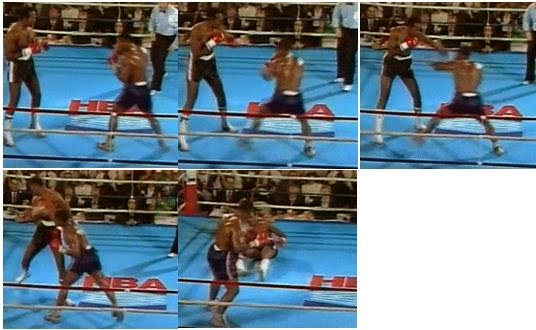
 This is best explained visually.


 In the pictures above, Mike starts his combination with a jab, which should noted as typically the right hand is not a leading punch, rather it is a follow up punch.  More importantly, you can see clearly in the first photo how his foot is so planted to push into the ground to generate the force for the right hand. In the second and through you can see the rotation and the snap of his should to explode into his target. Again I want to emphasize the snapping motion of the punch(which I wrote more about in another article), it is not a push, nor will the punch be powered by simple rotation.

 In the last photo, Mike demonstrates this punch with the rear pivoting and pushing into the ground until the punch is fully thrown, this is an important point and must be practiced ceaselessly.


 The moment immediately after impact should also be considered, as you are very vulnerable to counter attack. The followup punch after the right hand is typically a left hook; however, it can be any other punch by the left hand. Some fighters even throw the right straight in the doubles to disrupt the opponents counter punches.


 This punch is like the heavy artillery of boxing, however it does require a set up or at least a perfectly timed opportunity. This punch can leave you vulnerable. This punch follows the line of power very well, and that is why it is so strong. I will explain the line of power in a another article.


Wednesday, 2 July 2014

Peek-a-boo Jab and the Falling step

 I typically focus on attacking first because in the over all scheme of boxing hitting the target is very important. Although, footwork is an essential factor that makes or break a boxer, and I will discuss that in great detail in the next post. 


      On a side note, to accurately hit your target, the eyes need to be engaged in perceiving an opening, before a shot is fired. The eyes are essential in fighting, in other words punching blindly will only waste energy and leave you vulnerable. To look at what you about to hit, directs your energy through that target. 

 When it comes to the offensive movements, the basic punches are the jab, cross, hook, and the uppercut.  However, when you consider the angles and distances, these punches can transform into countless different forms. The literally transform into the mechanical movement that is needed in that instant. With enough practice, coordination and the ability to hit effectively from all angles can be achieved.
   To keep it simple, it is essential to master the basic forms of punches without the added angles and movements. But keep in mind that they are really principle punches and you are not bound by them. 


 The Jab needs no introduction, as it is the punch in boxing. However, in the peek-a-boo style, you are squared up with the opponent; thus. the amount of power it can generate is significant. In most styles, the lead arm rests more forward which is less effective for power but great for feinting or faking. I think in this style there are few wasted movements, every punch is meant to hurt.  This punch must be practiced without cease, as its refinement is only achieved through proper repetition. 


   The movement starts from the ground, with the rear foot pushing forward into the ground causing a force to travel of the leg into the hip which will cause a " falling front step"(explained in great detail by Jack Dempsey in his fantastic book CHAMPIONSHIP FIGHTING). This with torque the upper body to twist and here the shoulder snaps and an the arms explodes forward in a stabbing motion towards its target, while the wrist is twisting into a thumbs down position. This may seem like a lot of points to remember, but with practice it all becomes muscle memory and can be preformed subconsciously. 
  A professional boxer will know exactly what a proper jab will feel like when delivered properly but he does not need to think of the steps involved. Again with practice, this is accomplished. 


Sunday, 29 June 2014

From the Ground up!

 When I was in the army, I really appreciated moving close to the ground to avoid detection. I felt close to the earth, and yet since my legs were in a loaded position I could explode into any direction. Peek-a-boo style boxing moves the same way, it also needs the ability to move explosively in any direction.


In this picture Mike tyson squats down before exploding forward. 

 This style of fighting is very demanding and athletic because of this reason. It is rewarding with explosiveness, power, balance, and rapid defensive maneuvers. Different styles might have you standing up more, like muay thai, because there is practical point for that as well, such as dealing with kicks and knees. 
A lowered Stance has more stability and explosiveness, increasing the power of punches by using more force  of the leg muscles.

Mike tyson clearly shows the power transfer here, and even in Muay thai the lowered stance can be used to generate more power during rushes. 

Stance is best taught in person, but essential the weight is divided 50/50 between legs and the hips in this style square up with the opponent. Similar to sprint position only difference being that your hands are in a defensive posture, protecting the chin and ribs.
 I will post videos soon. 

The Foundation of a Fighter

       Since this is the first post, I will discuss the foundation of a fighter, his heart. This subject alone is a worth a million words, but I will only write about the necessary aspects. There are very few chances for a person to really see what they are made of in the average life. But when those moments arrive people will se who they really are.

      A heart is like a home, who lives in there will dictate what kind of a fighter your will become. If fear lives in your heart then you cannot fight, or at least you cannot fight well. There is no shame in experiencing fear;however, there needs be discipline to act despite the fear in order to be effective. A coward will experience fear and freeze or avoid the confrontation, while the courageous one will continue to fight while feeling the same fear as the coward. The sensation of fear, can be overwhelming for the inexperienced but like new sensations, they become less intense over time.

 Furthermore, there needs to be acceptance that pain, hard work, and sacrifice will be common part of this game. The pain I am referring to is not of injuries but rather of the wear of the tear that is necessary  to break down and rebuild a man into fighter. The inner world of the fighter is far more important that than his external abilities and limits. This is because without courage, no movement is authentic and the fighter is less effective.

 The only drill or practice with getting connected with your heart, is meditation. In that, you have to feel everything and not listen to the mind which is always looking for death around the corner. If you can listen to your heart, you may see something that will surprise you. As a fighter, or even a warrior, being in tune with the music of your heart is the only way you can win that belt or take that hill.

Moving on now, but I will come back to this topic later on.